Why BMW Owners in Dubai Should Never Skip the Annual Brake Inspection
A BMW 5 Series owner in Dubai Hills brings their car in for an oil service and mentions, almost as an afterthought, that the brake warning light appeared briefly two weeks ago and then disappeared. A quick ISTA+ scan reveals the front pads are at 2mm — the minimum threshold before sensor trigger — and the brake fluid moisture content is 3.8%, well above the 3% level at which we recommend replacement. The car had not had a brake inspection since its last service 18 months and 20,000 km ago. This is not unusual — it is, in fact, the norm for BMW owners in Dubai who rely entirely on the CBS (Condition Based Service) schedule rather than an annual brake check. BMW brake inspection in Dubai is not just a service item — it is a safety-critical annual investment that Dubai’s specific conditions make more urgent than the standard BMW maintenance calendar accounts for. This guide explains what a proper inspection covers, why Dubai accelerates brake wear, and what it actually costs.
Key Takeaways
- Dubai’s combination of speed bumps, summer heat, and motorway use creates a braking duty cycle that wears BMW pads and degrades brake fluid faster than the CBS schedule accounts for
- BMW uses electronic pad wear sensors — the brake warning light is the last resort, not the first alert; an annual measurement check is proactive and essential
- Brake fluid moisture absorption in Dubai’s summer humidity (80–90%) lowers wet boiling point below safe thresholds faster than BMW’s 2-year change interval
- Rear brake pads on newer BMWs with Electronic Parking Brake (EPB) can wear faster than fronts — a counterintuitive pattern that surprises many owners
- Prestige German Auto has been performing BMW brake inspections in Dubai since 2008, with a 4.9-star Google rating and same-day service for most brake work
Table of Contents
- Why Dubai Accelerates BMW Brake Wear
- What a Proper BMW Brake Inspection Covers
- Understanding the BMW Brake Warning Light
- Brake Fluid — The Most Overlooked Safety Item
- Electronic Parking Brake and Rear Pad Wear
- Brake Inspection and Service Costs in AED
- Frequently Asked Questions
- Dubai BMW Brake Maintenance Tips
Why Dubai Specifically Accelerates BMW Brake Wear
Speed Bumps — The Underestimated Factor
Dubai Hills, Business Bay, Motor City, Jumeirah Village Circle — virtually every residential community in Dubai has extensive speed bump infrastructure. A Dubai Hills resident may cross 10–15 speed bumps on every exit and return journey, applying the brakes from 20–30 km/h down to near-zero for each crossing, then accelerating away. This pattern of frequent low-speed, moderate-pressure brake applications accumulates brake pad wear at a rate that is genuinely different from European driving — where most braking occurs from higher speeds at less frequent intervals.
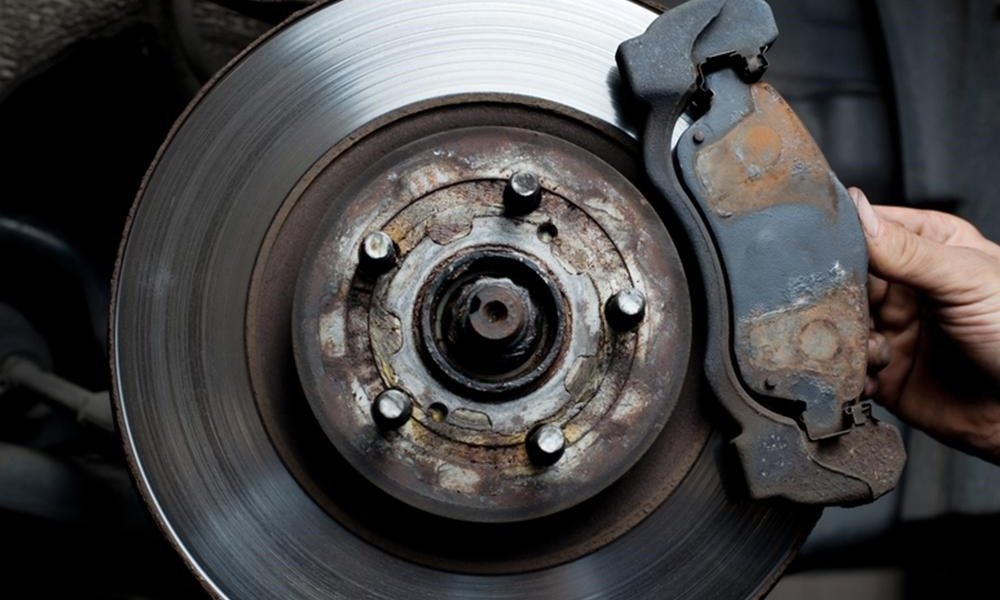
It also creates a different rotor wear pattern. Repeated low-speed applications at the same pad contact zone cause slight surface scoring on the rotor face over time — visible as a circumferential ridge at the outer edge of the pad swept area. This scoring reduces braking efficiency and generates the light metallic squeal that many Dubai BMW owners notice after 30,000–40,000 km and assume is brake dust.
Summer Heat and Brake Component Degradation
Brake pad friction material, caliper rubber seals, and brake fluid all perform within temperature envelopes that Dubai’s summer ambient conditions push toward their upper limits. Brake dust — the by-product of pad wear — accumulates faster on hot rotors and can cause surface glazing on pads that reduces friction coefficient. Caliper guide pins in the intense heat accumulate oxidation faster, causing uneven pad wear across the face of the pad (inner pad wears faster than outer, or vice versa). An annual inspection that includes caliper slide inspection and lubrication directly prevents the uneven wear pattern that halves effective pad life.
Motorway Driving Between Communities
Dubai’s residential communities are connected by high-speed motorway sections — the E311, E44, and SZR — where BMW owners routinely cruise at 120–140 km/h. Motorway emergency stops from these speeds generate far more heat energy in the brake system than the community speed bump stops described above. The combination of community low-speed repetitive braking and occasional high-speed motorway stops creates the most thermally diverse braking duty cycle of any major city in the region. This diversity — not just high heat — is what makes Dubai’s braking conditions uniquely stressful.
What a Proper BMW Brake Inspection Covers
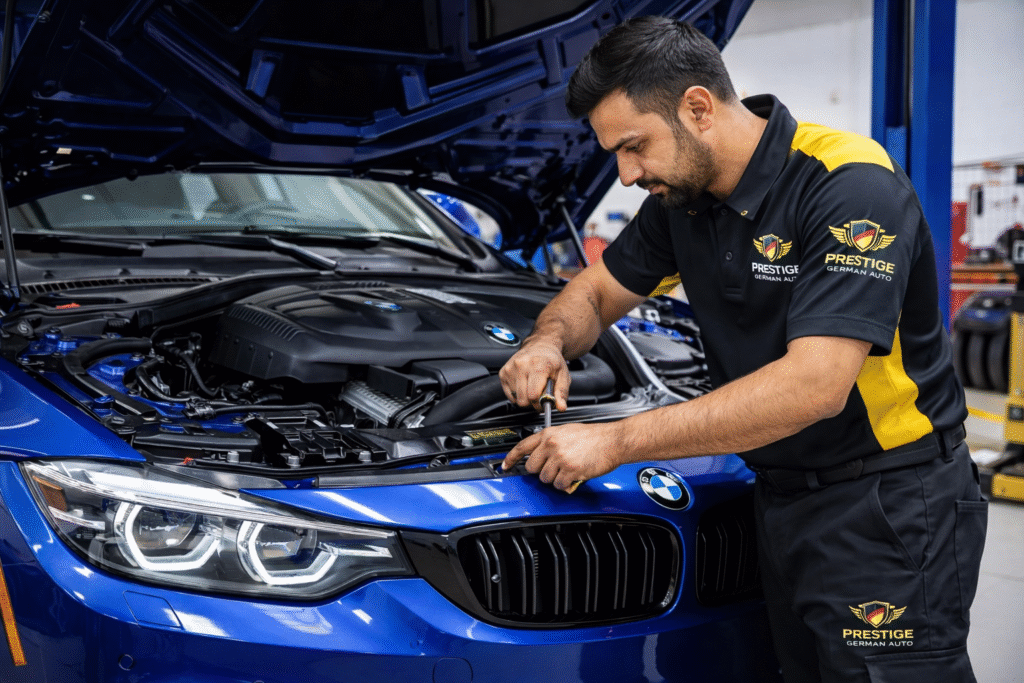
A genuine BMW brake inspection at Prestige German Auto covers eight specific checks — not just “we looked at the brakes” on a visual walk-around:
- Pad thickness measurement (all four corners) — Using a dedicated pad thickness gauge through the caliper window. Minimum service thickness is 3mm on most BMW models; we recommend replacement at 4mm to allow scheduling flexibility. We record measurements for comparison at future inspections.
- Rotor thickness and runout measurement — Rotor thickness is measured with a micrometer at 8 equidistant points around the rotor face to identify uneven wear (indicating caliper issues). Rotor runout is measured with a dial indicator to confirm the rotor is still running true — warped rotors cause pedal pulsation and vibration under braking.
- Brake fluid moisture content test — Using a dedicated brake fluid tester, we measure the percentage of water in the brake fluid at the master cylinder reservoir. Above 3% moisture content, we recommend replacement regardless of calendar interval.
- Caliper condition and slide freedom — Each caliper is inspected for guide pin freedom (slides must move freely and be properly greased), dust boot integrity (protects the guide pins from corrosion), and piston retraction (a piston that does not fully retract causes brake drag and uneven pad wear).
- Pad wear sensor continuity check — BMW’s electronic pad wear sensors are tested for continuity before the pads reach wear threshold. A sensor that has corroded or been damaged will not warn at the correct pad thickness — a critical safety check.
- Brake hose condition — Flexible rubber brake hoses at each corner are inspected for cracking, bubbling, or chafing. A deteriorated brake hose can fail catastrophically during a hard stop. In Dubai’s heat, hose rubber degrades at an accelerated rate.
- Handbrake/EPB function check — Electronic Parking Brake operation is verified via ISTA+ to confirm the actuator motors are operating within specification and the rear pads are applying evenly.
- ISTA+ stored fault codes — Any stored codes in the DSC/ABS module, EPB module, or instrument cluster related to the braking system are read and reported.
Understanding the BMW Brake Warning Light
BMW uses three distinct brake-related warning indicators that owners frequently confuse:
- Red circle with exclamation mark (parking brake symbol) — The handbrake/EPB is engaged, or there is a brake fluid level warning. If this appears while driving with the EPB released, check the brake fluid level immediately.
- Yellow exclamation mark (service indicator) — A pad wear sensor has triggered. This means one or more brake pads have reached their minimum thickness. Book a brake service promptly — you have days, not weeks, before metal-on-metal contact occurs.
- ABS or DSC warning light — Not a pad wear warning. These indicate a wheel speed sensor, ABS pump, or DSC system fault. Requires ISTA+ diagnosis — do not confuse with a brake wear issue.
The important message: waiting for the warning light before investigating brake condition means the pads are already at minimum specification. In Dubai’s summer motorway driving conditions, minimum-spec pads have very little safety margin remaining. An annual proactive measurement check — before any warning light appears — is the responsible approach.
Brake Fluid — The Most Overlooked Safety Item on a BMW in Dubai
BMW specifies DOT4 Low Viscosity fluid (specification 83 13 0 139 896) for all current models. This fluid has a dry boiling point of approximately 265°C and a wet boiling point (after moisture absorption) of approximately 185°C. The “wet” boiling point is what matters for safety — it represents the performance of the fluid as it actually exists in the car after absorbing atmospheric moisture.
Brake fluid is hygroscopic — it absorbs water vapour through the caliper seals and reservoir vent. In Dubai’s summer, when relative humidity reaches 80–90% from July through September, moisture absorption is meaningfully faster than in Europe’s typical 40–60% humidity range. An annual brake fluid test and change for Dubai BMW owners is not conservative — it is the correct interval for the actual operating environment. Brake fluid that reaches 3.5–4% moisture content has a wet boiling point of approximately 165–175°C — dangerously close to the temperatures generated by hard stops from motorway speed on a Dubai summer afternoon.
The symptom of boiled brake fluid is a spongy or fading pedal under repeated heavy braking. At road speeds, this is a safety emergency. The prevention costs AED 220–320 for a brake fluid flush annually. The consequence of ignoring it is a fading pedal on the E311 with an overtaking truck behind you.
Electronic Parking Brake and Rear Pad Wear — Why BMWs Are Different
Newer BMW models (F30 3 Series, G30 5 Series, G01 X3, G07 X7, and others) use an Electronic Parking Brake (EPB) rather than a conventional cable-and-lever handbrake. The EPB uses small electric actuator motors mounted on the rear calipers to apply and release the parking brake. This introduces a brake wear pattern that surprises many BMW owners: the rear brake pads can wear faster than the fronts.
The mechanism is this: the EPB actuator on some BMW models applies a slight residual clamping force during low-speed driving as part of the vehicle’s hill-hold and brake assist functions. This can cause the rear pads to accumulate more wear during urban stop-start driving — particularly the community speed-bump driving pattern described above — than the rear pads would on a conventional cable handbrake car. We measure rear pads separately from fronts at every inspection; do not assume that because the fronts are fine the rears are also fine on an EPB-equipped BMW.
EPB actuator faults are also diagnosed via ISTA+ and can cause a range of issues: rear brake drag (causing abnormal fuel consumption and rear pad wear), a parking brake that does not fully apply (a safety issue), or an EPB that cannot be retracted without ISTA+ intervention. Our BMW brake service always includes EPB actuator function verification.
BMW Brake Inspection and Service Costs in AED — Dubai
| Service | Prestige German Auto | BMW Dealer (approx.) |
|---|---|---|
| Full BMW Brake Inspection (8-point, all corners) | AED 150 – 250 | AED 300 – 500 |
| Front Brake Pad Replacement (OEM spec) | AED 650 – 1,100 | AED 1,200 – 2,200 |
| Rear Brake Pad Replacement (OEM spec) | AED 550 – 950 | AED 1,000 – 1,800 |
| Front Rotor Replacement (OEM equivalent, pair) | AED 900 – 1,600 | AED 1,800 – 3,200 |
| Brake Fluid Flush + Refill (DOT4 LV) | AED 220 – 320 | AED 450 – 700 |
| Caliper Service (guide pins, boots, lubrication) | AED 200 – 400 | AED 400 – 800 |
| EPB Actuator Replacement (per corner) | AED 700 – 1,200 | AED 1,400 – 2,400 |
A full annual brake inspection at Prestige German Auto takes approximately 45–60 minutes and is included at no charge with any service booking. We provide a written brake condition report with measured pad thickness values and rotor thickness readings at all four corners. Combined with a BMW oil service and suspension check, it forms part of a complete annual health assessment.
Frequently Asked Questions
How often should BMW brake pads be replaced in Dubai?
It varies significantly by model, driving style, and route. A BMW 3 Series used primarily for Dubai community driving (speed bumps, city stops) will typically need front pads at 30,000–40,000 km. The same car used mainly for motorway commuting may last 50,000–60,000 km. Rather than guessing by mileage, measure at every service and replace at 4mm remaining. An annual measurement check is the most reliable approach and eliminates the risk of the warning light being your first alert. We measure and record pad thickness at every service visit.
Is the BMW brake warning light reliable in Dubai’s heat?
The pad wear sensor system itself is reliable — when it works. The vulnerability is the sensor wire. In Dubai, the heat and occasional water exposure during car washes can cause the pad wear sensor wire to become brittle and crack, causing the warning light to illuminate even on new pads, or alternatively, for a corroded sensor to fail to warn when the pad is genuinely worn. At every brake inspection we test sensor continuity — a corroded sensor that will not warn at the correct threshold is replaced as a safety item, not an optional extra.
My BMW brakes feel fine — do I still need an annual inspection in Dubai?
Yes. Brake fade from degraded fluid, uneven caliper wear, and rotor scoring do not produce obvious symptoms until they are well advanced. A brake that “feels fine” in everyday Dubai community use will behave differently during an emergency stop from 120 km/h on the E311. The annual inspection is specifically designed to catch the developing issues that feel normal until they do not — marginal fluid, borderline pad thickness, a slightly seizing caliper guide pin — before they matter in an emergency situation.
Why are my BMW rear brake pads wearing faster than the fronts in Dubai?
On EPB-equipped BMW models, the rear EPB actuators can apply a slight residual braking force during urban driving as part of brake assist functions, accelerating rear pad wear disproportionately. Community speed-bump driving — frequent low-speed full stops — exaggerates this pattern. Additionally, some EPB actuator faults cause the rear pads to drag slightly even when the parking brake is released. If your rear pads consistently wear faster than fronts, an EPB actuator check via ISTA+ identifies whether there is a mechanical cause beyond normal rear-biased wear.
How much does a BMW brake inspection cost near Dubai Hills?
A full 8-point BMW brake inspection at our Al Quoz workshop — which is approximately 15 minutes from Dubai Hills — costs AED 150–250 and includes a written condition report with measured values. If you are booking an oil service or any other work at the same time, the brake inspection is included at no charge. We find this is the most common discovery scenario: a car brought in for a routine oil change where the brake inspection reveals pads at 3–4mm and fluid at 3.5% moisture — both addressable in the same visit at combined savings versus returning separately.
Dubai BMW Brake Maintenance Tips
- Book an annual brake inspection every May — before the summer heat peak. May is the ideal timing: brake fluid that has absorbed moisture through winter humidity is at its highest moisture content before summer heat starts, and pad wear accumulated over a year of community driving is measurable before the high-temperature summer months place the greatest demands on the system. A May inspection and any required brake work puts your BMW in the best possible condition for June–September.
- Change brake fluid annually, not every 2 years. BMW’s 2-year brake fluid change interval is a European calendar. Dubai’s summer humidity — 80–90% in July–August — accelerates moisture absorption significantly. Annual changes at AED 220–320 maintain the fluid’s wet boiling point above 185°C regardless of season. This is the single most cost-effective safety improvement available to any Dubai BMW owner who drives at motorway speeds.
- Do not use the EPB to hold the car on slopes regularly. Using the Electronic Parking Brake to hold an automatic BMW on an incline — rather than using the footbrake or the hill-hold function — applies a sustained clamping load on the rear pads through the EPB actuator. In Dubai’s residential communities with frequent ramp exits and car park spirals, this habit accelerates both rear pad wear and EPB actuator motor wear. Use the footbrake or the automatic hill-hold system for short stationary stops on inclines.
- Have rotor runout checked if you feel a pulsing brake pedal. A pulsing or vibrating pedal under braking is almost always a warped or high-runout rotor — not a pad issue. In Dubai, rotors can develop thermal runout from repeated emergency stops followed by prolonged stationary periods (the hot rotor develops an uneven heat distribution as it cools unevenly). Rotor replacement or machining resolves this. Do not allow a vibrating pedal to continue — the condition worsens progressively and creates uneven pad wear.
- Ask for a written brake measurement report at every service. Any reputable BMW workshop should provide measured pad thickness values (in mm) and rotor thickness values at all four corners after an inspection. If you receive only a verbal “brakes are fine,” ask for the numbers. Having a written record allows you to track wear rate between services and plan brake work on your schedule — before the warning light makes the decision for you.
BMW Brake Inspection Specialists — Dubai Hills and Al Quoz
Prestige German Auto has been carrying out BMW brake inspections and repairs in Dubai since 2008. Our Al Quoz Industrial Area 4 workshop is approximately 15 minutes from Dubai Hills, 20 minutes from Motor City, and 25 minutes from Arabian Ranches — serving the full southern Dubai BMW community. We provide written brake inspection reports with measured values, carry OEM-equivalent and genuine BMW brake pads and rotors in stock, and complete most brake services on a same-day basis.
With a 4.9-star Google rating, Fix Now Pay Later payment options, and a 3-month/10,000 km warranty on all brake work, we are the trusted independent BMW brake specialist for Dubai Hills, Motor City, and broader southern Dubai. Beyond brakes, we service all aspects of BMW maintenance: engine repair, gearbox service, suspension, AC regas, and oil change.
Due an annual brake check? Call us on +971 55 273 3911 or WhatsApp for a free assessment. Book your BMW brake inspection online or find us on Google Maps. Email: germanautouae@gmail.com.
🛑 BMW Brakes: Don’t Wait for the Warning Light. Get Measured Today.
📞 Call: +971 55 273 3911
💬 WhatsApp — Free Assessment
📅 Book Online
📍 Al Quoz Industrial Area 4, Dubai | Written Brake Reports | 3-Month / 10,000 km Warranty
Get a Free Estimate
Further reading: Brake Repair Dubai | BMW Repair Dubai | Engine Repair Dubai | Oil Change Dubai | Transmission Repair Dubai | Suspension Repair Dubai | AC Repair Dubai | Battery Replacement Dubai | Mercedes Repair Dubai | Audi Repair Dubai | Range Rover Repair Dubai