Complete Mercedes E-Class Suspension Repair Guide for Dubai Roads
The Mercedes E-Class is engineered to deliver one of the most refined driving experiences in the executive saloon segment — a cabin so isolated from road imperfection that, on smooth European motorways, it borders on the ethereal. Dubai’s roads tell a different story. Speed bumps installed without consistent height standards, patches of uneven tarmac in older districts, kerbs encountered at speed in multi-storey car parks, and summer temperatures that accelerate every form of rubber degradation — these realities make Mercedes E-Class suspension repair in Dubai a far more frequent need than most owners anticipate. This guide covers everything you need to know: which components fail first, what the symptoms tell you, what the repair involves, and what it costs at Prestige German Auto versus the main dealer.
Key Takeaways
- The Mercedes E-Class is available with either standard steel coil spring / shock absorber suspension or the optional AIRMATIC air suspension — each with distinct fault patterns in Dubai’s conditions.
- Dubai speed bumps and kerbing are the primary mechanical causes of suspension damage on Dubai E-Class vehicles; heat-driven rubber degradation is the primary chemical cause.
- AIRMATIC air spring bladders on the W212 and W213 E-Class typically develop leaks in Dubai at 70,000–100,000 km due to accelerated heat degradation.
- A knocking sound from the front suspension on an E-Class in Dubai is most commonly a failed top mount or worn control arm bush — both straightforward repairs when caught early.
- Prestige German Auto carries out full E-Class suspension diagnostics using XENTRY, covering both physical component assessment and electronic suspension control module scanning.
E-Class Suspension Systems: Standard vs AIRMATIC
Understanding which suspension system your E-Class has is the essential starting point for any diagnosis or repair. Mercedes fitted two fundamentally different suspension systems to the E-Class across the W212 (2009–2016) and W213 (2016–2023) generations, and the fault patterns are distinct between them.
Standard Suspension (Steel Springs and Hydraulic Shock Absorbers)
The base and mid-grade E-Class variants — the E200, E220d, and E250 in most UAE market configurations — use conventional steel coil springs with hydraulic shock absorbers at all four corners. This is a mechanically simpler system that is inherently more robust to physical impact (a hard speed bump strike, for example) than an air suspension system. The components that wear are predictable: shock absorbers, top mounts, control arm bushes, and anti-roll bar link rods.
AIRMATIC Air Suspension (Optional on W212, Standard on Higher W213 Specs)
Higher specification E-Class variants — the E300, E350, E400, E500, and the E63 AMG in both W212 and W213 — were frequently specified with AIRMATIC. On the W213, AIRMATIC was standard on E350+ and available on the E300 as an option. This system replaces the conventional coil springs with air springs (pneumatic rubber bladders), controlled by an air compressor and a suspension control module that continuously adjusts ride height and damping. The result is exceptional ride quality on smooth roads — and a more complex fault diagnosis picture in Dubai.
How Dubai’s Roads and Climate Accelerate E-Class Suspension Wear
Speed Bumps: The Primary Mechanical Threat
Dubai’s residential communities, school zones, and shopping centre access roads are densely populated with speed bumps of wildly varying height and profile. Some are gently ramped and easy to negotiate at low speed; others are blunt, steep-sided obstacles that transfer significant impact forces directly into the suspension components on any vehicle that doesn’t slow to a near-standstill. On the E-Class, the top mount — a rubber-isolated bearing that connects the shock absorber to the vehicle body — absorbs much of this impact. Repeat strikes at inappropriate speed accelerate top mount deterioration significantly.
Heat: The Primary Chemical Threat
Every rubber component in the E-Class suspension system — control arm bushes, anti-roll bar end links, top mount isolators, and on AIRMATIC models the air spring bladders themselves — is subject to accelerated degradation in Dubai’s ambient temperatures. At 45°C+ for four to five months per year, rubber compounds harden, lose elasticity, and eventually crack. Components that would last eight to ten years in a European climate fail in four to six years in Dubai’s heat cycle.
Kerbing in Urban Driving
Dubai’s urban driving environment — compact parking structures in Business Bay and Downtown Dubai, tight residential turning circles in Jumeirah and Arabian Ranches — puts the E-Class suspension through a range of low-speed impacts that gradually compromise wheel alignment and, in more severe cases, damage lower control arms and wheel bearings. We carry out wheel alignment checks as a routine part of every suspension diagnosis at our Al Quoz workshop.
Warning Signs: How to Identify an E-Class Suspension Problem
The E-Class is a well-insulated vehicle — suspension noise is partially absorbed by the sound deadening that is part of its premium specification. This means that by the time a suspension fault becomes clearly audible to the driver, the underlying component failure is often at an advanced stage. Watch for these early indicators:
- Knocking from the front suspension over speed bumps or rough tarmac — the most common early symptom. Typically indicates a worn top mount or failed anti-roll bar end link.
- Car pulling to one side under braking — indicates uneven suspension geometry, often caused by a collapsed control arm bush on one side.
- Steering wheel vibration at certain speeds — often related to a worn wheel bearing or suspension component that has affected wheel balance.
- Uneven tyre wear — particularly inner-edge or outer-edge wear on the front tyres, indicates a wheel alignment problem driven by worn suspension components.
- The car sitting lower on one side (AIRMATIC models) — indicates a failed air spring bladder or a valve block fault affecting one corner.
- AIRMATIC warning light on the dashboard — the suspension control module has detected a fault. Do not ignore this — the compressor can be damaged by running continuously to compensate for an air leak.
- Harsh, choppy ride quality on surfaces that previously felt smooth — indicates shock absorber wear, where the hydraulic fluid inside the unit has degraded and the damping action is reduced.
The Most Common E-Class Suspension Faults in Dubai
Top Mount Failure (Front and Rear)
The top mount is a rubber-and-bearing assembly that isolates the shock absorber from the vehicle body. It provides controlled movement in the steering axis and absorbs high-frequency vibration. In Dubai’s heat and on Dubai’s speed bumps, the rubber isolator within the top mount cracks and loses its damping characteristics, and the bearing wears. Symptoms: knocking over bumps, steering column vibration. This is one of the most cost-effective suspension repairs we carry out — and one that makes a dramatic difference to the driving experience when renewed.
Control Arm Bush Deterioration
The E-Class W213 uses an aluminium multi-link front suspension with rubber-bonded bushes at each pivot point. These bushes control the precise geometry of each wheel relative to the chassis. As they harden and crack with age and heat exposure, the geometry drifts, causing uneven tyre wear, steering imprecision, and a vague, floating sensation over undulating road surfaces. Bush replacement requires pressing the old bush out and the new one in — a job requiring proper equipment and an alignment check on completion.
Anti-Roll Bar End Links
The anti-roll bar end links connect the anti-roll bar to the suspension strut on each side. They are a high-wear component on any vehicle driven over Dubai’s speed bumps regularly. Failed end links produce a distinctive rattle or clunk from the relevant corner — typically heard most clearly when negotiating slow, sharp speed bumps. Replacement is a relatively minor repair and comparatively inexpensive — but it is a repair that is often deferred because the noise is intermittent, until the failed link causes secondary wear on the adjacent components.
Shock Absorber Wear
Hydraulic shock absorbers on the standard E-Class suspension are a wear item — not a fixed-life component, but one that degrades gradually over approximately 60,000–80,000 km under Dubai’s demanding driving conditions. Symptoms of worn shocks are subtle initially: a slightly less composed ride over rough surfaces, mild front-end dive under braking, and a slight wallowing sensation over large undulations. We test shock absorber condition as part of every suspension inspection using a bounce test and visual inspection for oil seepage from the shock body.
AIRMATIC Air Suspension on the E-Class — A Dubai Specialist’s Guide
The AIRMATIC system on the Mercedes E-Class is electronically sophisticated — managed by a dedicated suspension control module that receives inputs from ride height sensors at each corner, the vehicle speed signal, and steering angle sensor. Understanding how this system interacts is essential for correct diagnosis and for avoiding the misdiagnosis of a software or sensor fault as a physical component failure.
Air Spring Bladder Failure
In Dubai’s climate, AIRMATIC air spring bladders on the W212 E-Class typically begin to develop slow leaks at 70,000–100,000 km — earlier than equivalent mileage vehicles in cooler markets. The rubber bellows of the air spring are the most thermally stressed component in the system. A failing bladder allows air to escape slowly: the car drops overnight and the compressor runs excessively during the day to compensate. Early detection and replacement prevents compressor burnout.
Height Sensor Faults
Each corner has a ride height sensor that provides the suspension module with its reference data. In Dubai’s sandy environment, the sensor linkages can seize or corrode, providing incorrect data that causes the system to inflate or deflate asymmetrically. XENTRY diagnostic scanning at our Mercedes specialist workshop identifies height sensor faults clearly — preventing incorrect air spring replacement based on a sensor-generated misdiagnosis.
Air Compressor Failure
The AIRMATIC compressor on the E-Class sits in the boot area and is protected by a dryer/filter unit. In Dubai’s dusty conditions, the filter element becomes blocked more rapidly than in cleaner environments, restricting airflow and forcing the compressor motor to work harder. Regular filter replacement is a preventive measure that extends compressor life significantly.
Repair Cost Guide: Mercedes E-Class Suspension in Dubai (AED)
| Repair | Prestige German Auto (AED, est.) | Authorised Dealer (AED, est.) |
|---|---|---|
| Front top mount replacement (per side) | AED 600 – 1,100 | AED 1,100 – 2,000 |
| Control arm bush replacement (per arm) | AED 800 – 1,500 | AED 1,500 – 2,800 |
| Anti-roll bar end link replacement | AED 300 – 600 | AED 600 – 1,100 |
| Shock absorber replacement (per corner, standard) | AED 800 – 1,600 | AED 1,500 – 2,800 |
| AIRMATIC air spring replacement (per corner) | AED 1,200 – 2,000 | AED 2,200 – 3,800 |
| AIRMATIC compressor replacement | AED 1,500 – 2,800 | AED 3,000 – 5,000 |
| Wheel alignment (4-wheel, post-repair) | AED 200 – 350 | AED 400 – 700 |
All repairs carry a 3-month / 10,000 km warranty. Fix Now Pay Later available.
Frequently Asked Questions
Why does my Mercedes E-Class make a knocking noise over speed bumps in Dubai?
A knocking sound from the front suspension when crossing Dubai’s speed bumps is most commonly caused by a worn top mount bearing or rubber isolator, or a failed anti-roll bar end link. Both are relatively minor repairs that make an immediate and significant difference to ride quality and NVH. A physical inspection at Prestige German Auto — combined with a XENTRY scan to exclude any electronic suspension fault — will confirm the source within an hour of the vehicle arriving at our Al Quoz workshop.
How long do Mercedes E-Class shock absorbers last in Dubai?
On standard suspension E-Class models driven in Dubai, hydraulic shock absorbers typically last 60,000–80,000 km. AIRMATIC damper units may last slightly longer as they are controlled electronically and not subject to the same continuous mechanical stress. Dubai speed bumps and the general road quality in older districts accelerate wear compared to smoother European road networks.
What does the AIRMATIC warning light mean on my Mercedes E-Class?
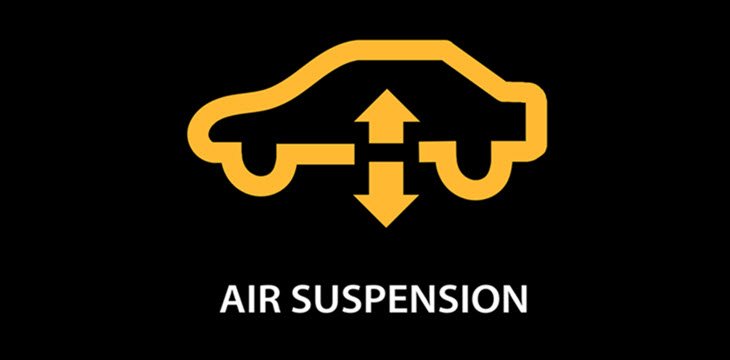
The AIRMATIC warning light — displayed as an icon of a car with a suspension symbol, or as a text warning on the instrument display — indicates that the suspension control module has detected a fault. This could be a physical fault (air spring leak, compressor failure, height sensor failure) or an electronic fault (sensor signal out of range, module communication fault). A XENTRY scan at Prestige German Auto will read the specific fault code stored by the module and guide the correct diagnosis. Do not continue driving with this light active if the vehicle is sitting noticeably lower on any corner — the compressor will be damaged by continuous operation trying to compensate for a leak.
Can I drive my Mercedes E-Class with a suspension fault in Dubai?
It depends on the fault. A minor anti-roll bar end link rattle does not affect vehicle safety for short distances. A failed AIRMATIC system that has defaulted to minimum ride height significantly reduces ground clearance and suspension travel — driving over speed bumps in this condition risks contact between the undercarriage and the road surface. If the vehicle is sitting noticeably low, have it assessed before driving further.
My Mercedes E-Class (W213) suspension feels harsh and choppy over the small surface imperfections on Dubai’s roads. Is this a fault or normal?
The W213 E-Class AIRMATIC is one of the most refined suspension systems in the executive saloon segment and should feel very smooth on normal road surfaces. If the ride quality has deteriorated, this is a fault rather than a characteristic. Common causes include worn air spring bladders (which lose their compliance as the rubber ages), height sensor drift causing incorrect ride height calibration, or — on models without AIRMATIC — worn shock absorbers. A suspension inspection at Prestige German Auto will identify the cause.
How much does Mercedes E-Class AIRMATIC repair typically cost in Dubai?
At Prestige German Auto in Al Quoz, a single air spring replacement on the E-Class AIRMATIC costs AED 1,200–2,000, compared to AED 2,200–3,800 at an authorised Mercedes dealer. Compressor replacement costs AED 1,500–2,800 at Prestige German versus AED 3,000–5,000 at the dealer. The diagnostic scan is included with the repair.
4 Dubai-Specific Mercedes E-Class Suspension Maintenance Tips
- Always slow to walking pace over Dubai speed bumps. This sounds obvious — but the sustained impact of crossing a steep speed bump at 20 km/h instead of 5 km/h delivers dramatically different forces into the top mounts and control arm bushes. The single most effective thing an E-Class owner can do to extend suspension component life in Dubai is to reduce speed bumps impact speed.
- Have wheel alignment checked after any significant kerbing or pothole impact. The E-Class’s multi-link suspension is designed to precise geometry tolerances. A hard kerbing event — common in Business Bay’s basement car parks and Arabian Ranches’ tighter turning areas — can knock the alignment out of specification even without visible damage. Misaligned wheels cause rapid tyre wear and additional stress on suspension components. We carry out wheel alignment checks as part of every suspension service.
- Book an AIRMATIC system check before the summer peak. April is the optimal time to have the AIRMATIC system inspected — refrigerant pressure, compressor output, height sensor calibration, and air spring condition — before the temperature extremes of May through September. A marginal air leak that is manageable in cooler months becomes a compressor-burning problem in 47°C ambient heat when the compressor runs continuously.
- Replace anti-roll bar end links at the first sign of noise. These are among the cheapest suspension components on the E-Class. Deferring replacement because the rattle is intermittent allows the failed link to impose additional stress on the anti-roll bar mounts and the adjacent suspension components — turning a AED 400 repair into a significantly more expensive one.
Book Your Mercedes E-Class Suspension Assessment in Dubai
Whether your E-Class has developed an AIRMATIC fault, an audible suspension knock, or a gradual deterioration in ride quality that you suspect is suspension-related, Prestige German Auto in Al Quoz is ready to assess it. We use XENTRY diagnostic equipment alongside physical suspension inspection to identify both electronic and mechanical faults correctly before any work is recommended. We have been serving Dubai’s Mercedes community since 2008, with a 4.9-star Google rating and a 3-month / 10,000 km warranty on all work carried out.
Call us on +971 55 273 3911 or WhatsApp to arrange an assessment. Same-day bookings accepted. Book online here. Find us on Google Maps.
Book Your Mercedes E-Class Suspension Repair Today
📞 Call: +971 55 273 3911
💬 WhatsApp: Chat with us now
📧 Email: germanautouae@gmail.com
🗺 Find us on Google Maps
📅 Book online
Al Quoz Industrial Area 4, Dubai | Mon–Sat 8am–7pm
Get a Free Estimate
Related services: suspension repair | brake repair | engine repair | gearbox service | oil change | AC repair | battery | body repair
Also serving: BMW suspension Dubai | Audi suspension Dubai | Porsche repair Dubai | VW repair Dubai | Range Rover air suspension