
Mercedes C-Class Air Conditioning Not Cooling? Here’s What Dubai Heat Does to Your Compressor
It begins with a subtle change — the air coming from the vents feels slightly less sharp than it should. A week later you are sitting in traffic on Sheikh Zayed Road, the thermometer outside reading 46°C, and your Mercedes C-Class is blowing warm air into a cabin that feels like the inside of an oven. Mercedes C-Class AC repair in Dubai is one of the most common jobs we carry out at Prestige German Auto throughout the summer months — and in almost every case, the root cause traces back to the same set of Dubai-specific factors that destroy automotive air conditioning systems faster than manufacturers ever intended. This guide explains exactly what happens, why it happens in Dubai specifically, and what it costs to put it right.
Key Takeaways
- Dubai’s summer ambient temperatures of 42–50°C force the Mercedes C-Class AC compressor to operate at maximum load for extended periods, dramatically accelerating wear on internal components.
- Refrigerant leak — through seals degraded by heat — is the single most common cause of a Mercedes C-Class AC blowing warm in Dubai.
- Driving with a partially failed AC system in Dubai is not just uncomfortable — it can cause secondary heat damage to the compressor that turns a minor repair into a major one.
- XENTRY diagnostic scanning is essential to identify climate control module faults that mimic compressor failure but are resolved by software recalibration rather than parts replacement.
- Prestige German Auto carries out same-day AC diagnosis and most AC repairs within 24 hours at our Al Quoz workshop.
How Your Mercedes C-Class Air Conditioning System Works
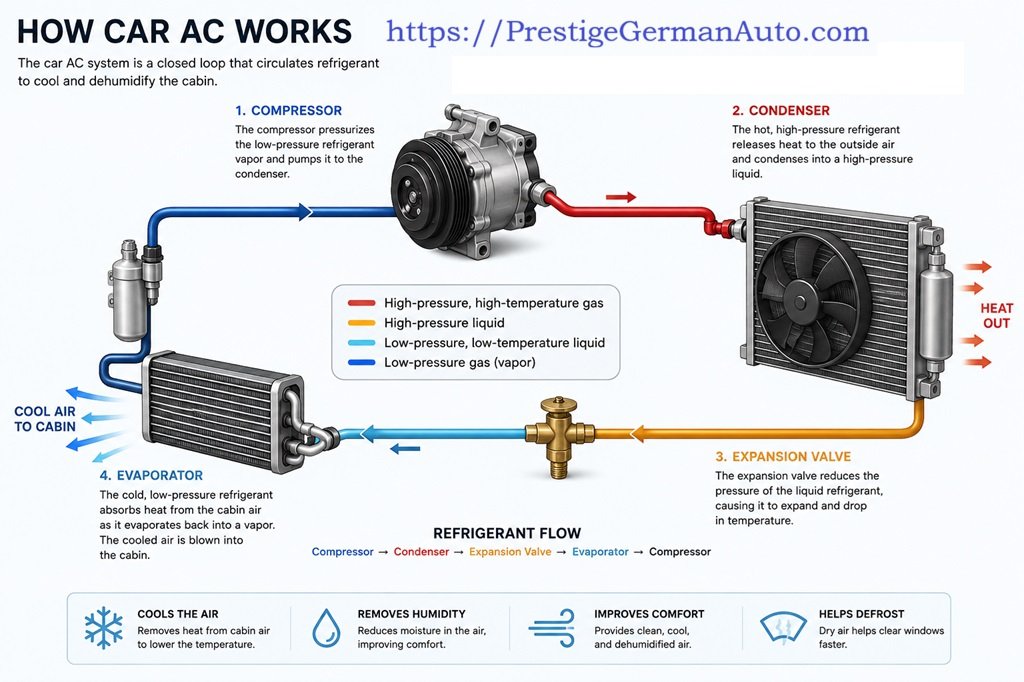
The Mercedes C-Class uses a closed-loop refrigerant circuit — on current W205 and W206 models, this uses R-1234yf refrigerant; older W204 models use R-134a. The circuit compresses refrigerant gas (which generates heat), then passes it through the condenser at the front of the vehicle to shed that heat, before expanding it through the evaporator inside the cabin to produce the cooling effect.
The compressor is the heart of this system. On the C-Class, Mercedes fits an electromagnetic clutch-type compressor (on older W204 models) or an electronically controlled variable displacement compressor (on W205/W206). The variable displacement unit adjusts its output continuously — theoretically a more efficient design, but one that is more sensitive to oil contamination and refrigerant quality than the simpler clutch-type predecessor.
Sitting alongside the compressor in the diagnostic picture is the climate control module (KLA) — an electronic control unit that manages the blending of warm and cold air, the distribution to different zones, and the compressor’s operating parameters. On the W205 C-Class, this module communicates over the CAN bus with the main engine control unit, the comfort control module, and the instrument cluster. A fault anywhere in this communication chain can present as an AC failure without any physical component having failed.
What Dubai’s Summer Heat Does to Your Mercedes C-Class AC Compressor
The Mercedes C-Class AC compressor was designed and validated in European testing conditions — typically ambient temperatures between 25°C and 35°C for thermal load testing. In Dubai’s summer, ambient temperatures routinely reach 42–50°C. This is not a marginal increase. It fundamentally changes the operating conditions for every component in the refrigerant circuit.
The Compressor Load Problem
In European summer conditions, the AC compressor might run at 60–70% capacity for a portion of the journey and reduce load as the cabin cools. In Dubai, from the moment you start the engine in a sun-exposed car park — cabin temperature potentially exceeding 65°C after sitting in direct sun — the compressor runs at or near maximum capacity. This sustained high-load operation generates heat within the compressor housing itself, degrades the lubricating oil that protects the compressor internals, and accelerates wear on the shaft seals and internal valve plates.
Condenser Efficiency Reduction
The condenser — the component at the front of the vehicle that releases heat from the refrigerant — operates by dissipating heat into the ambient air. At 46°C ambient, its efficiency is dramatically reduced compared to a 25°C ambient. The compressor must work harder to compensate, increasing load further. In Dubai traffic — where the vehicle is often stationary with reduced airflow across the condenser — this effect is amplified.
Seal and O-Ring Degradation
Every joint in the refrigerant circuit is sealed with rubber O-rings. These degrade in extreme heat. In Dubai’s climate, O-rings that might last ten years in a European market vehicle can develop micro-porosity and begin to allow refrigerant to escape in four to six years. The result is a slow refrigerant leak that initially presents as reduced cooling performance before progressing to no cooling at all — as the circuit drops below the minimum pressure threshold required for the compressor to operate.
Symptoms: Identifying the Fault Before It Gets Worse
Catching a Mercedes C-Class AC fault at an early stage matters — particularly in Dubai’s summer, where driving without functioning air conditioning is not merely uncomfortable but potentially dangerous in the extreme heat. The progression of symptoms typically follows a predictable pattern:
- Stage 1 — Reduced cooling efficiency: The cabin takes longer than usual to cool down. On a moderately hot day (35°C) the system performs acceptably; on extreme heat days it struggles to maintain the set temperature.
- Stage 2 — Intermittent warm air: At idle or in slow traffic, the vents begin blowing warm. At speed, with more airflow across the condenser, cooling partially returns.
- Stage 3 — Consistently warm or ambient temperature air: The system can no longer maintain any meaningful cooling. The compressor may cut in and out or fail to engage at all.
- Stage 4 — Compressor noise: A rattling, squealing, or knocking noise from the engine bay when the AC is selected indicates a compressor that has reached mechanical failure — often a seized bearing or failed internal valve. At this stage, secondary damage to the rest of the circuit from metal particle contamination is a risk.
Do not ignore Stage 1 or Stage 2. A refrigerant top-up and leak repair at that point costs a fraction of a full compressor replacement at Stage 4.
The Most Common Mercedes C-Class AC Faults in Dubai
1. Refrigerant Leak (R-134a / R-1234yf)
The most common cause of a warm-blowing Mercedes C-Class in Dubai. The leak can be at any joint in the circuit — condenser connections, compressor shaft seal, evaporator connections, or the service port valves. We use UV dye injection and UV lamp inspection to locate leaks precisely before recharging the system. Simply recharging without locating and repairing the leak is money wasted — the refrigerant will escape again within weeks.
2. AC Compressor Failure
At its most basic, compressor failure on the W205 C-Class presents as a system that does not cool at all, with no compressor engagement audible when AC is selected. On the variable displacement compressor, internal valve failure can allow compressor engagement but with no effective refrigerant pumping. Compressor replacement on the C-Class requires full system evacuation, compressor oil flush, new compressor installation, and system recharge — not a simple job, but a predictable one for a specialist.
3. Expansion Valve Failure
The expansion valve regulates refrigerant flow from the high-pressure side to the evaporator. A failed expansion valve presents as icing of the evaporator (frost visible at the cabin air intake) or wildly inconsistent cooling. This component fails more frequently in vehicles that have been operated on a partially-depleted refrigerant charge — the mixture of refrigerant and oil that passes through the valve is not at the correct ratio, causing wear on the valve seat.
4. Climate Control Module (KLA) Fault
The KLA module on the W205 C-Class can store fault codes that disable compressor operation as a protective measure. These codes — P0532, P0533, B1293, and others — can be caused by a voltage spike, a sensor failure, or a software issue rather than any physical AC component having failed. A XENTRY scan at our Mercedes repair workshop will identify these codes and allow us to determine whether the fault is electronic or physical before any component is replaced.
5. Condenser Damage or Blockage
The condenser sits at the front of the vehicle, directly behind the front bumper. In Dubai’s sandstorm conditions, it can become blocked with fine dust that reduces airflow and therefore cooling efficiency. It is also vulnerable to stone chip damage — even a small perforation causes refrigerant loss. We inspect the condenser as part of every AC diagnosis.
Repair Cost Guide: Mercedes C-Class AC in Dubai (AED)
| Repair | Prestige German Auto (AED, est.) | Authorised Dealer (AED, est.) |
|---|---|---|
| AC diagnostic scan (XENTRY) | Included with repair | AED 350 – 600 |
| Refrigerant recharge (R-134a) | AED 250 – 400 | AED 450 – 700 |
| Refrigerant recharge (R-1234yf, W205/W206) | AED 400 – 650 | AED 700 – 1,100 |
| Leak repair (O-ring / fitting) | AED 300 – 700 | AED 600 – 1,200 |
| AC compressor replacement (W205) | AED 2,200 – 3,800 | AED 4,000 – 6,500 |
| Expansion valve replacement | AED 600 – 1,100 | AED 1,100 – 2,000 |
| Condenser replacement | AED 1,200 – 2,200 | AED 2,200 – 3,800 |
Prices are indicative and vary by exact model year and fault complexity. All repairs carry a 3-month / 10,000 km warranty.
Frequently Asked Questions
Why is my Mercedes C-Class AC not cold in Dubai summer?
In the vast majority of cases, a Mercedes C-Class blowing warm in Dubai’s summer has either a refrigerant leak (the most common cause), a failed compressor, or a climate control module fault code that has disabled the compressor as a protective measure. A XENTRY scan and refrigerant pressure test will identify which within 30–45 minutes of the vehicle arriving at our Al Quoz workshop.
Can I drive my Mercedes C-Class without air conditioning in Dubai?
Technically yes — but it is inadvisable for any journey beyond a few minutes in summer. Cabin temperatures in a parked vehicle in Dubai can exceed 65°C; at speed without AC the cabin will reach 50°C+ in direct sun. More importantly, driving with a partially failed AC system — where the compressor is engaging and disengaging erratically — risks mechanical damage to the compressor that significantly increases repair cost.
How often should I service the AC on my Mercedes C-Class in Dubai?
We recommend an AC system check — refrigerant pressure, compressor function, condenser condition, and interior temperature drop test — annually. Given Dubai’s summer demands, combining this with your annual oil service in March or April, before the extreme heat, is ideal. The system works its hardest between May and September, so entering summer with a fully charged, fully functional AC is essential.
My Mercedes C-Class AC blows cold when driving fast but warm in traffic — what is this?
This is a classic condenser efficiency symptom. At speed, airflow across the condenser is high and the system operates correctly. In traffic, with reduced airflow, the condenser cannot shed heat efficiently enough for the refrigerant circuit to maintain sufficient pressure. The immediate cause is usually a partially depleted refrigerant charge or a clogged condenser face. Book a Mercedes AC inspection with us before the fault progresses.
Does Prestige German Auto carry out Mercedes AC repair for C-Class vehicles from JVC or nearby areas?
Yes. We serve Mercedes C-Class owners from JVC, Jumeirah, Business Bay, Downtown Dubai, DIFC, Arabian Ranches, Dubai Hills, and across the city. Our workshop in Al Quoz Industrial Area 4 is 10–15 minutes from JVC via Al Khail Road. Same-day AC assessment is available — WhatsApp +971 55 273 3911 to confirm availability.
My Mercedes climate control shows an error code on the dashboard — does that mean the compressor has failed?
Not necessarily. A climate control fault code can indicate a sensor failure, a voltage issue, a software fault in the KLA module, or a physical component failure. Only a XENTRY diagnostic scan can confirm which. We have resolved a significant number of apparent compressor failures at Prestige German Auto through software recalibration and sensor replacement rather than compressor replacement — saving clients thousands of dirhams in unnecessary parts cost.
5 Tips to Protect Your Mercedes C-Class AC in Dubai’s Climate
- Park in shade or a covered car park wherever possible. A vehicle parked in direct sun with a cabin temperature of 65°C puts maximum thermal stress on every component — including the AC system — the moment you start the engine and demand full cooling output.
- Pre-cool the cabin before driving. On modern C-Class models (W205/W206), the remote start or app-based pre-conditioning function allows the AC to begin cooling the cabin before you enter. Using this reduces the initial compressor load spike significantly.
- Have the system recharged at the correct specification. Using the wrong refrigerant type (R-134a in an R-1234yf system or vice versa) or incorrect refrigerant quantity causes rapid component damage. Always ensure the workshop uses the correct specification for your specific model year.
- Replace the cabin air filter on schedule. A blocked cabin filter reduces evaporator airflow, which causes the evaporator to ice up and the system to work harder. On the C-Class, this is a simple, inexpensive replacement that significantly impacts system efficiency — particularly relevant in Dubai’s dusty conditions.
- Do not run the AC on recirculation mode continuously. Recirculation mode is efficient for rapid cooling, but using it exclusively causes carbon dioxide levels inside the cabin to rise over extended journeys. Switch to fresh air intake periodically to maintain interior air quality and reduce the humidity load on the evaporator.
Book Your Mercedes C-Class AC Repair at Prestige German Auto
A Mercedes C-Class blowing warm air in Dubai’s summer is not a minor inconvenience — it is a fault that will worsen, cost more to repair if left unattended, and make every journey actively unpleasant in temperatures that leave no room for a failed cooling system. At Prestige German Auto in Al Quoz, we carry out same-day AC diagnostics and most AC repairs within 24 hours. We have served Dubai’s Mercedes community since 2008, with a 4.9-star Google rating and a 3-month / 10,000 km warranty on every repair.
Call us on +971 55 273 3911 or WhatsApp to book your Mercedes C-Class AC assessment today. Fix Now Pay Later available on larger repairs. Find us on Google Maps.
Book Your Mercedes AC Repair Today
📞 Call: +971 55 273 3911
💬 WhatsApp: Chat with us now
📧 Email: germanautouae@gmail.com
🗺 Find us on Google Maps
📅 Book online
Al Quoz Industrial Area 4, Dubai | Mon–Sat 8am–7pm
Get a Free Estimate
Related services: full AC repair service | engine repair | oil change service | brake repair | suspension repair | battery replacement | body repair
Also serving: BMW AC repair Dubai | Audi AC repair Dubai | Porsche repair Dubai | VW repair Dubai | Range Rover repair Dubai